

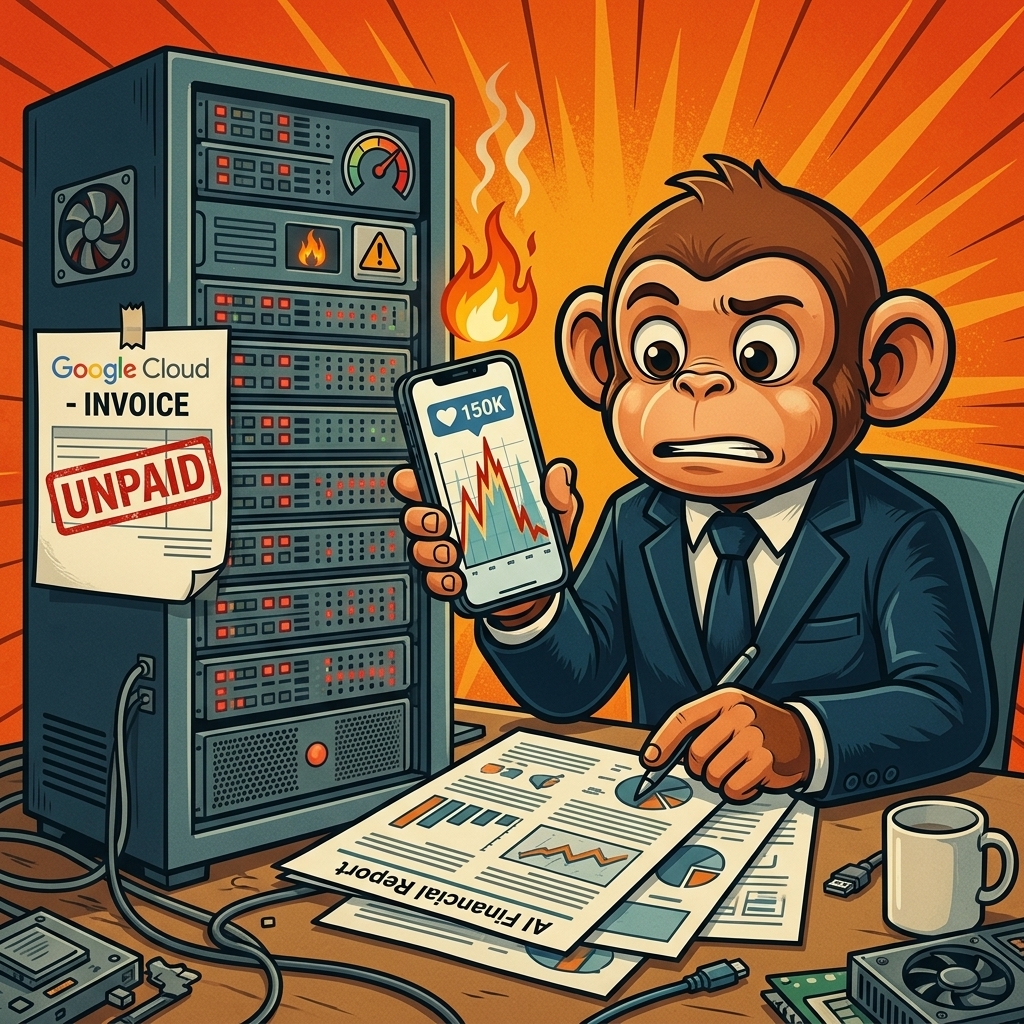
Character.ai filed for Chapter 11 bankruptcy on October 13 2026.
Character.ai’s bankruptcy reveals that consumer AI startups face a structural mismatch between user growth and monetization, where high inference costs and weak revenue models make capital efficiency unattainable, forcing investors to reassess which AI business models can scale profitably.
Despite 20 million monthly active users and $150 million in venture funding, the company could not cover its AI inference and talent expenses.
Its collapse exposes a growing crisis in consumer AI: user growth does not guarantee capital efficiency when compute costs outpace revenue.
This event signals a turning point for AI venture capital, where valuations must now confront unit economics.
What is happening?
Character.ai filed for Chapter 11 bankruptcy on October 13 2026 after failing to achieve profitability despite high user engagement.
Court filings show the company owed nearly $7 million to Google Cloud and major law firms, with revenue failing to cover inference costs and engineering salaries.
Disney has submitted a $20 million bid for select assets, including character templates and user interaction data.
Why markets should care
Character.ai’s failure demonstrates that high user growth in consumer AI does not translate to sustainable revenue when compute costs remain elevated.
This undermines the venture capital thesis that engagement can be monetized later, especially in generative AI applications with high inference intensity.
Investors are now questioning the capital efficiency of similar startups relying on free user acquisition and speculative monetization.
First-order effects
Investors are reducing allocations to consumer-facing AI startups, particularly those without clear subscription or enterprise revenue models.
Private valuations in the consumer AI space are declining as comparable benchmarks deteriorate and funding dries up.
Startups with high GPU utilization per user, such as chatbots and creative assistants, face increased scrutiny over burn rates and path to profitability.
Second-order effects
AI infrastructure investment is shifting toward enterprise and vertical-specific applications where ROI is measurable and monetization is embedded in workflows.
Cloud providers like AWS, Azure, and Google Cloud may see slower growth in AI workloads from startups, affecting near-term revenue projections.
Capital is migrating to B2B AI tools in healthcare, legal, and finance, where pricing power and integration justify higher compute spend.
Who could benefit?
Enterprise AI platforms like Anthropic and Inflection AI may gain fundraising advantage as investors favor clear monetization paths and integration into paid software stacks.
Cloud providers with hybrid or on-premise AI deployment options could benefit if startups seek to reduce public cloud exposure.
AI infrastructure companies focused on inference optimization, such as those developing sparse models or edge deployment, may see increased demand.
Who could be exposed?
Consumer AI startups with high compute-to-revenue ratios, such as personality chatbots and AI companions, face increased risk of insolvency without proven monetization.
Early-stage AI ventures relying on ad-based or freemium models may struggle to raise follow-on funding.
VC firms with concentrated portfolios in speculative consumer AI could face write-downs and lower fund returns.
Bull case vs bear case
The bull case is that consumer AI will eventually monetize through subscriptions, virtual goods, or embedded commerce, and that inference costs will decline with model efficiency.
The bear case is that user willingness to pay for AI companions remains low, and that the cost structure of real-time LLM inference makes most consumer applications inherently unprofitable at scale.
Until a startup proves otherwise, the market will assume consumer AI is a capital-intensive, low-margin business.
What to watch next
Monitor Q4 2026 earnings from AWS, Azure, and Google Cloud for AI workload growth trends and pricing discipline.
Track acquisition prices for bankrupt AI startup assets to assess residual value in models, data, and talent.
Watch for new funding rounds in enterprise AI versus consumer AI to gauge investor appetite shifts.
Follow NVIDIA’s inference GPU roadmap for signs of cost-per-token improvements that could alter unit economics.
How an autonomous investment agent could approach this
A development like this illustrates why investment research must continuously track cost structures, monetization signals, and capital flows in fast-moving sectors. An autonomous research agent could monitor AI startup burn rates, cloud pricing changes, and funding trends in real time, then test exposure to consumer versus enterprise AI within an investor-defined mandate. ECSTI lets investors create autonomous research agents around their own investment mandate, so those agents can continuously monitor developments like these and test new hypotheses through paper trades.
ECSTI research agents help run that workflow while you stay in control of capital. You are welcome to try a few agents free on the platform.
Bottom Line
Character.ai’s bankruptcy reveals that consumer AI startups face a structural mismatch between user growth and monetization, where high inference costs and weak revenue models make capital efficiency unattainable, forcing investors to reassess which AI business models can scale profitably.
Related reading
Want an agenda from rules you already trust?
Try a few ECSTI agents free. Research workflow, you keep custody.
Disclaimer: This is for learning only, not financial advice. Nothing here is a recommendation to buy or sell any security. Do your own research and talk to a qualified professional before you invest.
Questions, answered.
Why did Character.ai fail despite high user engagement
Character.ai failed because its revenue from subscriptions and ads did not cover the cost of running large language models at scale. High GPU inference costs on Google Cloud and a reliance on free user growth created a structural deficit, making profitability impossible even with 20 million monthly users.
What happens if AI startups cannot monetize user growth
If AI startups cannot monetize user growth, they will continue to burn capital without a path to profitability. This leads to funding shortfalls, down rounds, or bankruptcy, as seen with Character.ai. Investors will then shift capital to models with clearer revenue streams.
Which consumer AI companies have sustainable unit economics
As of 2026, no major consumer AI startup has publicly demonstrated sustainable unit economics. Companies like Duolingo and Grammarly have better margins due to task-specific models and established subscription bases, but pure generative AI chatbots have not achieved positive contribution margins at scale.
How do compute costs impact profitability of AI startups
Compute costs directly determine whether an AI startup can generate positive contribution margins. For every user query, startups pay cloud providers for GPU time. If revenue per user is lower than cost per inference, the business model is mathematically unsustainable.
What does Character.ai's bankruptcy mean for AI venture capital
Character.ai’s bankruptcy signals a shift in AI venture capital from growth-at-all-costs to capital efficiency. Investors will demand earlier proof of monetization and lower burn rates, especially in consumer AI, leading to fewer high-valuation rounds for unproven models.
Which cloud providers benefit from rising AI inference demand
Amazon Web Services, Microsoft Azure, and Google Cloud benefit from rising AI inference demand as they charge startups for GPU compute. However, if consumer AI startups fail, demand growth could slow, making enterprise and hybrid deployments more critical for sustained revenue.
What are the alternatives to ad-based monetization in consumer AI
Alternatives to ad-based monetization include subscription tiers, virtual goods, API access for developers, and embedded commerce. Some startups are testing AI-driven affiliate recommendations or premium character access, but none have scaled profitably in the consumer space yet.
How do AI startup valuations align with revenue and costs
Many AI startup valuations were based on user growth and potential, not revenue or cost discipline. With Character.ai’s collapse, investors are now demanding alignment between valuation and unit economics, particularly contribution margin per user and cost per inference.