

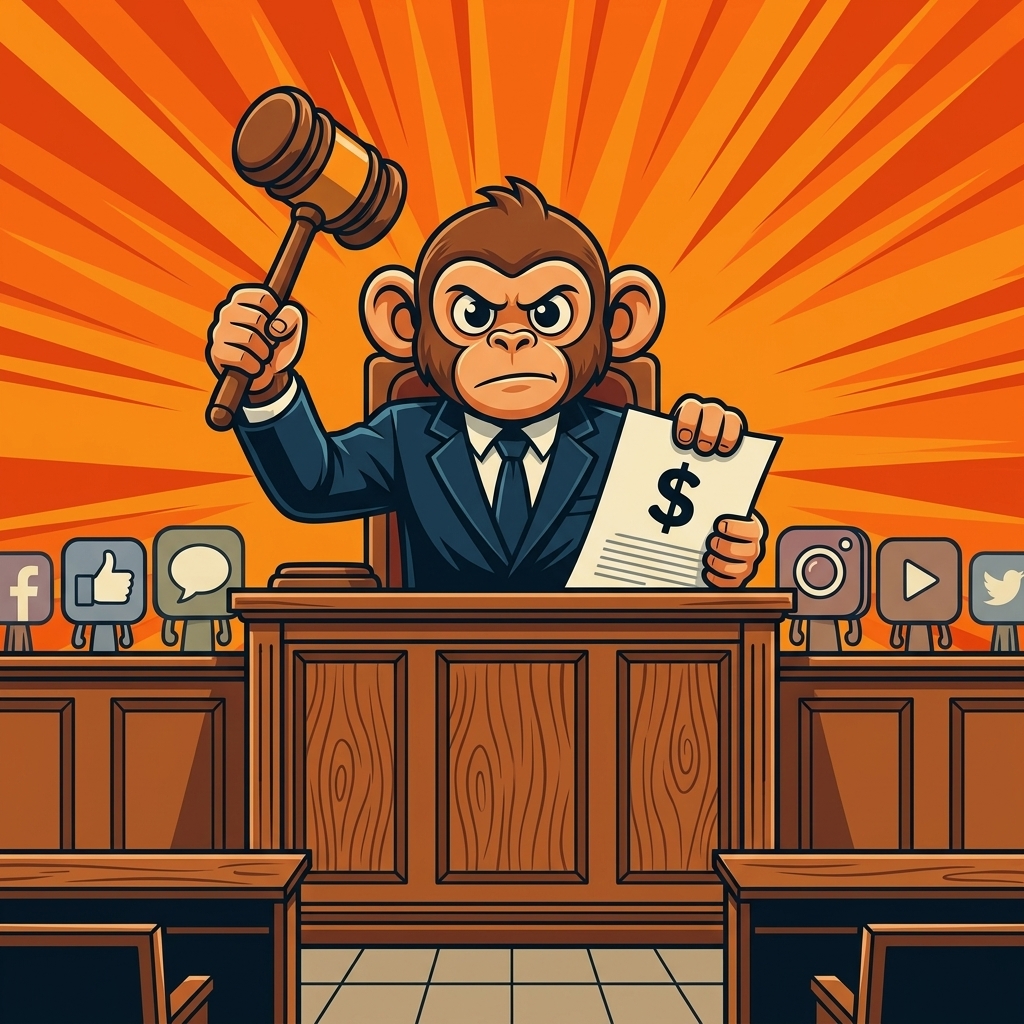
On August 26, 2026, Meta agreed to pay up to $18 billion to settle claims brought by 29 states alleging its platforms caused addiction and psychological harm to minors. The settlement was reached mid-trial, with state attorneys general participating directly. Multiple news organizations reported figures ranging from $16.68 billion to $18 billion depending on the payment structure and scope of claims included. It is the largest social media liability settlement on record.
The Hook:
The Meta settlement does not simply impose a one-time charge on one company. It converts algorithmic harm to minors from an unquantified legal theory into a demonstrated, dollar-denominated outcome. That conversion changes how plaintiffs price their cases, how state AGs sequence their dockets, and how analysts should treat litigation reserves at Snap, Alphabet, and Pinterest. The insight the headline does not carry: the settlement's most consequential effect may not be on Meta at all, but on smaller platforms whose market caps cannot absorb a proportionally similar claim.
On August 26, 2026, Meta agreed to pay up to $18 billion to settle claims brought by 29 states alleging its platforms caused addiction and psychological harm to minors. The settlement was reached mid-trial, with state attorneys general participating directly. Multiple news organizations reported figures ranging from $16.68 billion to $18 billion depending on the payment structure and scope of claims included. It is the largest social media liability settlement on record.
Before this settlement, platform litigation risk over algorithmic harm to minors was real but imprecise. Plaintiffs had a legal theory. They lacked a proven dollar outcome. That changed on August 26. A settled case with a known payment range gives opposing counsel a valuation anchor, removes the argument that the harm theory is untested, and hands state AGs a replicable playbook. The question for investors is not what this costs Meta. The question is what it implies for every other platform still in active litigation.
What the settlement actually established
Meta did not admit liability. Settlements in US civil litigation rarely include admissions, and this one is no exception. That legal distinction matters for how the precedent travels. A settlement is not a court ruling. It does not bind other defendants or establish case law that courts must follow.
What it does establish is a demonstrated willingness by a major platform to pay a very large sum rather than let a jury decide. That signal carries weight in litigation strategy. Plaintiffs' attorneys and state AGs now have a concrete outcome to reference when negotiating with other defendants. The uncertainty defense, which argues that harm has never been quantified, becomes harder to sustain when the largest defendant in the category has just quantified it through a settlement payment.
The settlement also reportedly includes behavioral commitments: time limits for teen users, changes to algorithmic recommendation features, and restrictions on certain engagement mechanics. Those operational changes matter because they create a compliance record that other platforms will feel pressure to match, both to reduce litigation exposure and to avoid appearing as the least-reformed actor in the category.
Why the settlement is not simply a Meta story
Meta's balance sheet can absorb $18 billion. The company generated over $50 billion in free cash flow in 2024. The settlement is a significant charge, but it is not an existential one. Meta's more interesting role here is as the bellwether defendant whose outcome sets the terms for everyone else.
Multi-district litigation works through bellwether cases. One defendant's settlement or verdict gives all parties a pricing signal. Plaintiffs use it as a floor. Defendants use it to estimate their own exposure. The Meta outcome is now that signal for the entire social media category.
State AGs who participated in the Meta action have political and institutional incentive to replicate it. They have the legal theory, the discovery record from the Meta trial, and a demonstrated settlement outcome. Filing parallel actions against Alphabet, Snap, and Pinterest requires less groundwork than the original Meta case did. The litigation infrastructure already exists.
It is worth being precise about what is speculative here. Whether other platforms settle, on what timeline, and for what amounts depends on their specific products, user demographics, internal documents produced in discovery, and the jurisdictions where cases are filed. The Meta settlement does not automatically transfer to other defendants. But it changes the negotiating environment materially.
Snap faces a structural mismatch between exposure and capacity
Snap is the most exposed public platform by the ratio of implied liability to balance sheet capacity. This is not a claim about legal guilt. It is an observation about financial structure.
Snap's enterprise value as of mid-2026 is a fraction of Meta's. If plaintiffs apply a similar per-user or per-claim framework to Snap's teen user base, the resulting dollar figure, even if smaller in absolute terms than Meta's settlement, could represent a much larger share of Snap's equity value. A $2 billion settlement would be manageable for Meta. For Snap, it would be a different kind of event.
Snap has disclosed litigation risks related to minor safety in its SEC filings. The company faces active suits in several jurisdictions. The Meta settlement does not resolve those suits, but it changes the leverage plaintiffs hold in settlement negotiations. Snap's management will face direct questions about litigation reserves on its next earnings call, and analysts who have not yet built a range of contingent liability scenarios into their models will need to do so.
Pinterest faces a related dynamic. Its historically high teen user penetration and visual content format make it a logical target for the next wave of state AG actions. Pinterest's revenue base is smaller than Alphabet's, and its litigation reserve disclosures have been limited relative to the scale of claims that could follow the Meta template.
Alphabet's YouTube exposure is different in kind, not in direction
Alphabet's exposure runs through YouTube, specifically YouTube Kids and the general YouTube recommendation engine's accessibility to minors. The FTC has previously fined Google over COPPA violations related to YouTube. That regulatory history gives state AGs a documented record of prior harm findings to build on.
YouTube's recommendation algorithm has been the subject of academic research and congressional testimony regarding its effects on young users. The Meta settlement gives plaintiffs a stronger basis to argue that algorithmic amplification of harmful content to minors is an industry-wide practice, not a Meta-specific one.
Alphabet's scale means it can absorb a large settlement more easily than Snap or Pinterest. But the earnings impact of a multi-billion dollar reserve, combined with the operational cost of compliance changes to YouTube's recommendation systems, would be material. Alphabet has not disclosed a specific litigation reserve for minor-harm claims in its recent filings, which means analysts are currently modeling this exposure with limited information.
ByteDance is not a platform stock, and that distinction matters
TikTok and ByteDance appear in nearly every discussion of teen social media harm, and the underlying concern is legitimate. TikTok's short-video format and recommendation engine have been the subject of congressional hearings, state AG investigations, and academic studies on adolescent mental health.
But ByteDance is a private Chinese company. It is not listed on a US exchange. Investors cannot buy or sell ByteDance shares in a public market. The liability exposure that applies to Meta, Snap, Alphabet, and Pinterest as public equities does not apply to ByteDance in the same way, because there is no public market price to reprice.
The more relevant investment question around TikTok is whether US-listed platforms bear compliance and settlement costs that TikTok does not, creating an asymmetric cost burden. If Meta, Snap, and Alphabet spend billions on settlements and compliance infrastructure while TikTok operates under different enforcement dynamics, the competitive playing field shifts. That is a second-order effect worth tracking, but it is speculative at this stage.
How platform balance sheets should be read differently now
Contingent liabilities are disclosed in the notes to financial statements, not on the face of the balance sheet, unless a loss is both probable and estimable under US GAAP. Before the Meta settlement, most platform companies could argue that the probability and magnitude of algorithmic harm settlements were too uncertain to require a specific reserve. That argument is harder to sustain now, though it has not disappeared entirely. A settlement by one defendant does not automatically make another defendant's loss probable in the legal accounting sense.
What changes is the analyst's job. Sell-side models that treat platform litigation as a binary tail risk, either zero or catastrophic, are no longer adequate. The Meta settlement provides a data point for building a probability-weighted range. Analysts can now estimate a per-user or per-revenue dollar ratio from the Meta outcome and apply it to other platforms' disclosed teen user bases, adjusting for product differences and jurisdictional factors.
That exercise will produce a wide range of estimates, and the inputs are contested. But the exercise is now necessary. Investors who do not attempt it are implicitly pricing the litigation backlog at zero, which is no longer a defensible assumption.
One structural cost that is more certain than settlement amounts is compliance capital expenditure. Platforms building a litigation defense record will invest in age verification, parental consent systems, and algorithmic audit infrastructure. Those costs are real, recurring, and will appear in operating expense lines regardless of how individual lawsuits resolve.
Who could benefit from the settlement's second-order effects
Age verification and parental consent technology vendors are the clearest potential beneficiaries. Every platform now has a financial incentive to document compliance efforts before the next case reaches trial. Third-party identity and verification tools become a procurement priority rather than an optional feature. Companies in this space, including digital identity verification providers and consent management platforms, could see accelerated enterprise sales cycles.
Plaintiffs' law firms specializing in mass tort and consumer protection litigation gain a replicable template and a large fee precedent. The Meta settlement validates the legal theory and the scale of potential recovery. That will attract additional capital and legal talent into this litigation category, increasing the volume of future filings against other platforms.
Meta itself could benefit conditionally. Markets sometimes re-rate a stock upward after a large but bounded settlement because a known cost replaces open-ended uncertainty. If the $18 billion figure resolves the majority of state and plaintiff claims against Meta specifically, the removal of that litigation discount from Meta's valuation multiple is plausible. That outcome depends on whether the settlement's scope is broad enough to close most active cases, which is not yet clear from public reporting.
Liability insurers face a more complex position. The settlement updates their actuarial loss distribution upward for the platform category, which should produce premium increases. But insurers who have already written policies for platforms at pre-settlement pricing face adverse development on those books. The net effect on individual insurers depends on their existing exposure and policy terms.
What to watch in the next six months
The most important near-term signal is whether state AGs file new actions against Snap, Alphabet, or Pinterest citing the Meta settlement as a damages reference. That would confirm the litigation replication thesis and force those companies to disclose updated reserve estimates.
Snap and Pinterest earnings calls are the next disclosure opportunity. Listen for management commentary on litigation reserves, any change in legal expense guidance, and whether outside counsel costs are rising. A company that increases its legal reserve after a competitor settles is signaling that its own exposure assessment has changed.
Meta's 10-Q or 8-K filing will detail the settlement structure, payment schedule, and the scope of claims released. The payment schedule matters for cash flow modeling. If payments are spread over several years, the near-term earnings impact is smaller than the headline figure implies. The scope of claims released matters for understanding whether Meta's litigation overhang is actually resolved or merely reduced.
Congressional activity is worth monitoring but should be treated as a slower-moving variable. Legislative proposals related to child online safety have stalled repeatedly. The settlement gives advocates a concrete harm narrative and a dollar figure, which may accelerate bill introductions. But the path from introduction to enacted law is long, and the specific provisions of any legislation will determine whether the compliance cost burden is symmetric across platforms or creates winners and losers within the sector.
Digital advertising revenue trends in the under-18 demographic are a lagging indicator. If platforms restrict minor-facing ad inventory as a liability mitigation measure, that restriction will appear in revenue mix data over the following two to four quarters. Advertisers who rely heavily on teen-targeted social placements should monitor inventory availability and CPM trends across platforms.
How an autonomous investment agent could approach this
A development like this illustrates why platform equity research now requires continuous monitoring across legal dockets, regulatory filings, earnings disclosures, and legislative calendars simultaneously. The Meta settlement did not arrive as a single clean signal. It built through state AG filings, trial proceedings, mid-trial negotiations, and parallel regulatory actions across multiple jurisdictions over several years. An autonomous research agent configured around a platform equity mandate could track litigation reserve disclosures across Snap, Alphabet, and Pinterest filings, flag new state AG actions as they are filed, monitor age-verification vendor contract announcements, and test how changes in contingent liability estimates affect a portfolio's factor exposure, all without requiring a human analyst to manually aggregate those inputs each week. ECSTI lets investors build research agents around their own investment mandate so those agents can continuously monitor developments like these and test new hypotheses through paper trades. See how that works at /platform.
ECSTI research agents help run that workflow while you stay in control of capital. You are welcome to try a few agents free on the platform.
Bottom Line
The Meta settlement does not simply impose a one-time charge on one company. It converts algorithmic harm to minors from an unquantified legal theory into a demonstrated, dollar-denominated outcome. That conversion changes how plaintiffs price their cases, how state AGs sequence their dockets, and how analysts should treat litigation reserves at Snap, Alphabet, and Pinterest. The insight the headline does not carry: the settlement's most consequential effect may not be on Meta at all, but on smaller platforms whose market caps cannot absorb a proportionally similar claim.
The Meta settlement does not simply impose a one-time charge on one company. It converts algorithmic harm to minors from an unquantified legal theory into a demonstrated, dollar-denominated outcome. That conversion changes how plaintiffs price their cases, how state AGs sequence their dockets, and how analysts should treat litigation reserves at Snap, Alphabet, and Pinterest. The insight the headline does not carry: the settlement's most consequential effect may not be on Meta at all, but on smaller platforms whose market caps cannot absorb a proportionally similar claim.
Related reading
Want an agenda from rules you already trust?
Try a few ECSTI agents free. Research workflow, you keep custody.
Disclaimer: This is for learning only, not financial advice. Nothing here is a recommendation to buy or sell any security. Do your own research and talk to a qualified professional before you invest.
Questions, answered.
Why does Meta settling teen addiction lawsuits create a liability reference point for other social media platforms?
A settled case with a known payment range gives plaintiffs' attorneys and state AGs a dollar anchor and a validated legal theory. Before the Meta settlement, defendants could argue that algorithmic harm to minors had never been quantified in a legal outcome. After it, that argument is harder to sustain. Plaintiffs can now reference a demonstrated outcome when negotiating with Snap, Alphabet, or Pinterest, which changes the leverage in those negotiations even though the settlement does not bind other defendants as a matter of law.
What happens to Snap stock if courts use the Meta settlement as a damages benchmark in future cases?
Snap faces a structural mismatch between its potential liability exposure and its balance sheet capacity. If plaintiffs apply a per-user or per-claim ratio derived from the Meta settlement to Snap's teen user base, the resulting dollar figure, even if smaller in absolute terms, could represent a much larger share of Snap's equity value than the same calculation represents for Meta. Snap's enterprise value is a fraction of Meta's, so a proportionally similar settlement would be a more serious financial event. This is a risk to model, not a guaranteed outcome.
Which platform companies face the largest unresolved litigation backlog related to algorithmic harm to minors?
Based on public filings and reported litigation activity, Snap, Alphabet (YouTube), and Pinterest are the most prominent publicly traded platforms with active or anticipated minor-harm litigation following the Meta settlement. Snap has disclosed litigation risks in its SEC filings. Alphabet faces exposure through YouTube's recommendation algorithm and has prior FTC findings related to COPPA violations. Pinterest's teen user penetration and visual content format make it a logical target for state AG actions modeled on the Meta case.
What does the Meta teen mental health settlement mean for how analysts should model contingent liabilities on platform balance sheets?
The settlement provides a data point for building a probability-weighted liability range rather than treating platform litigation as a binary tail risk. Analysts can now attempt to derive a per-user or per-revenue dollar ratio from the Meta outcome and apply it to other platforms' disclosed teen user bases, adjusting for product differences and jurisdictional factors. The inputs are contested and the range of estimates will be wide, but the exercise is now necessary. Pricing the litigation backlog at zero is no longer a defensible assumption.
How should investors adjust the risk premium for social media stocks after a major algorithmic harm settlement establishes a legal precedent?
The settlement converts what was priced as a low-probability tail event into a demonstrated outcome with a known magnitude. That conversion justifies raising the expected litigation cost embedded in discount rates applied to platform cash flows. The adjustment should be proportional to each platform's teen user exposure, product design, and balance sheet capacity to absorb a settlement. Platforms with smaller market caps and higher teen user penetration relative to their revenue base warrant a larger risk premium adjustment than large-cap platforms with diversified revenue.
What does duty of care for recommendation algorithms mean for YouTube and TikTok legal exposure going forward?
Duty of care in this context refers to the legal argument that platforms have an obligation to design recommendation systems that do not cause foreseeable harm to minor users. The Meta settlement, while not a court ruling, demonstrates that this theory can produce large financial outcomes. For YouTube, prior FTC findings under COPPA and documented congressional testimony about recommendation algorithm effects on young users give state AGs a foundation to build on. TikTok faces similar theoretical exposure but is operated by ByteDance, a private Chinese company, which creates different enforcement dynamics than those facing US-listed platforms.
Which age verification and identity technology companies benefit if platforms rush to comply after the Meta settlement?
Platforms building a litigation defense record have a direct financial incentive to purchase third-party age verification and parental consent tools rather than build in-house systems. This creates a procurement tailwind for digital identity verification providers and consent management platforms. The demand is driven by the need to document compliance efforts before the next case reaches trial, making it more durable than a one-time regulatory response. Specific public companies in this space include identity verification vendors whose enterprise sales cycles could accelerate as platform legal teams prioritize compliance infrastructure.
How are liability insurers likely to reprice coverage for consumer internet platforms after this settlement?
Insurers model expected loss from litigation using historical outcomes. A settled case with a known payout updates the loss distribution upward for the entire platform category, which should produce premium increases on new policies. Insurers who have already written tech errors and omissions or product liability policies for platforms at pre-settlement pricing face adverse development on those existing books. The net effect on individual insurers depends on their current exposure and policy terms, but the directional pressure on premiums for new platform coverage is upward.