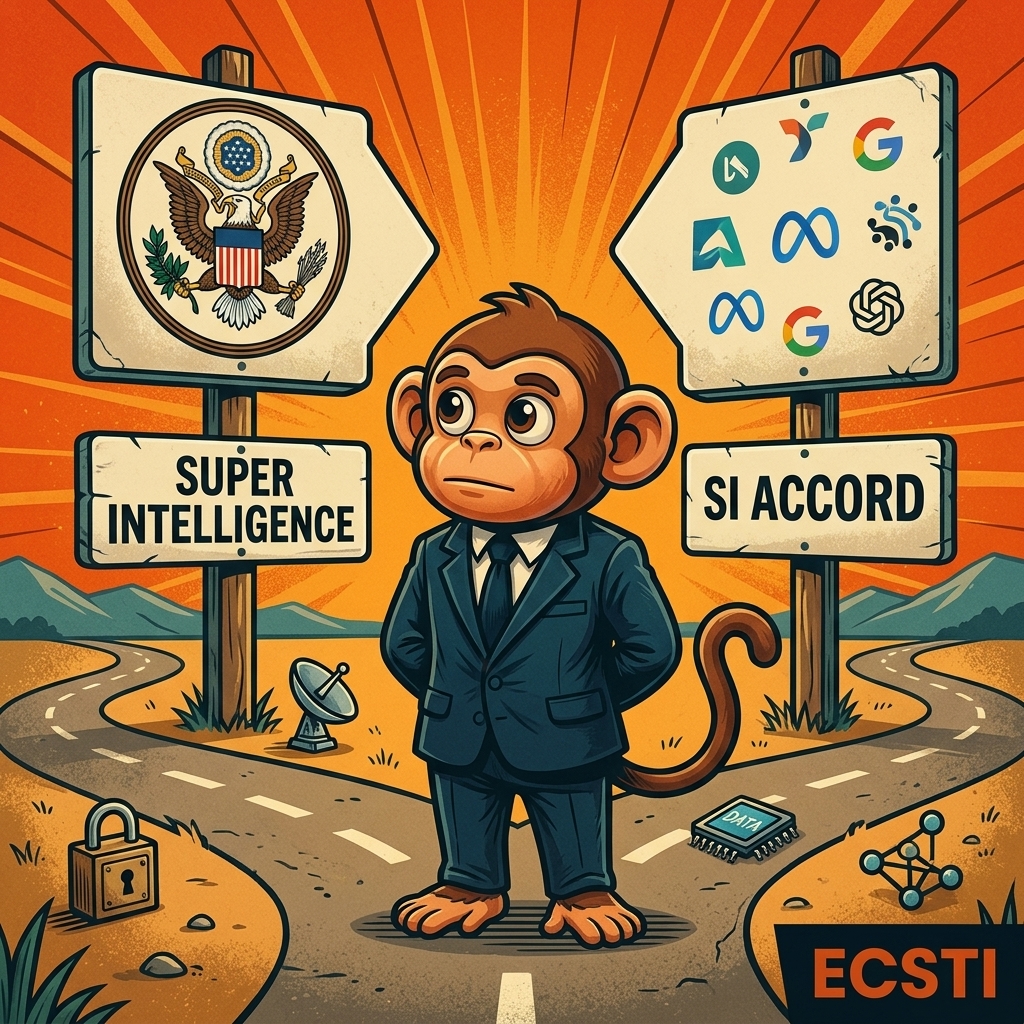
On September 30, 2026, President Trump signed an executive order rebranding artificial intelligence as 'Super Intelligence'.
The simultaneous rebranding of AI as 'Super Intelligence' by the Trump administration and the tech sector's self-coordination signals a strategic split in governance vision, increasing the risk of misaligned standards and regulatory fragmentation, with real consequences for compliance costs, infrastructure investment, and market access in AI-dependent sectors.
The same day, Microsoft, Google, Nvidia, and other tech leaders announced a private 'Super Intelligence Accord' to coordinate technical standards and safety protocols.
These parallel moves signal a strategic divergence in AI governance. The federal government now uses a politicized term detached from technical reality. The private sector has formed a self-regulatory bloc outside public oversight.
This split increases the risk of regulatory fragmentation, with real implications for compliance, infrastructure investment, and market access.
What is happening?
President Trump rebranded artificial intelligence as 'Super Intelligence' via executive order on September 30, 2026. The same day, Microsoft, Google, Nvidia, Meta, and OpenAI signed a private 'Super Intelligence Accord' to align on development standards.
The federal rebrand applies across all agencies and funding programs. The tech accord is a voluntary agreement on model transparency, testing, and compute governance. No government officials were involved in its drafting.
Why markets should care
Markets should care because regulatory fragmentation increases compliance costs and distorts capital allocation. When public and private standards diverge, companies must navigate two rulebooks.
This creates uncertainty in procurement, R&D funding, and export controls. It also raises the risk of regulatory capture, where large firms shape standards to lock out competitors.
First-order effects
Federal agencies must now use 'Super Intelligence' in all policy documents, grant solicitations, and regulatory frameworks. This creates immediate confusion in cross-sector coordination.
The tech accord establishes shared benchmarks for model safety and training transparency. Members gain preferential access to each other's testing frameworks and cloud infrastructure.
Second-order effects
Divergent definitions of 'Super Intelligence' could lead to mismatched safety requirements. Federal procurement may demand different model documentation than private certification.
Startups relying on federal grants and cloud services from accord members may face conflicting compliance demands. This could delay deployment and increase legal risk.
Who could benefit?
Large tech firms in the accord may benefit from reduced coordination costs and influence over standard-setting. Microsoft and Google control cloud platforms used by most AI startups, giving them gatekeeper power.
Nvidia could gain from fragmented infrastructure requirements, as different standards may justify additional hardware upgrades and proprietary toolchains.
Who could be exposed?
AI startups face the highest exposure. They lack the legal and engineering resources to comply with dual standards. Smaller firms may be excluded from federal grants if their models do not meet 'Super Intelligence' criteria.
Startups dependent on cloud infrastructure may be forced to adopt the accord's standards, even if they conflict with federal rules.
Bull case vs bear case
Bull case: The tech accord fills a regulatory vacuum. It enables faster innovation through shared testing and interoperability. Federal rebranding raises public awareness without binding technical impact.
Bear case: The split entrenches a two-tier system. Large firms shape private standards to exclude competitors. Federal rules become irrelevant, undermining public accountability and safety oversight.
What to watch next
Watch for the first federal procurement contract requiring 'Super Intelligence' compliance. That will reveal how strictly the rebrand is enforced.
Monitor whether non-accord firms like AMD or smaller AI labs are excluded from joint testing initiatives. Track whether startups begin citing regulatory confusion in earnings calls.
How an autonomous investment agent could approach this
A development like this shows why investment research must track policy and corporate coordination simultaneously. An autonomous research agent could monitor federal AI funding notices, tech alliance announcements, and startup compliance disclosures in real time. It could test how governance splits affect valuation multiples in cloud, semiconductor, and AI software sectors under a defined mandate. ECSTI lets investors build agents that continuously update hypotheses without replacing human judgment. /platform
ECSTI research agents help run that workflow while you stay in control of capital. You are welcome to try a few agents free on the platform.
Bottom Line
The simultaneous rebranding of AI as 'Super Intelligence' by the Trump administration and the tech sector's self-coordination signals a strategic split in governance vision, increasing the risk of misaligned standards and regulatory fragmentation, with real consequences for compliance costs, infrastructure investment, and market access in AI-dependent sectors.
Related reading
Want an agenda from rules you already trust?
Try a few ECSTI agents free. Research workflow, you keep custody.
Disclaimer: This is for learning only, not financial advice. Nothing here is a recommendation to buy or sell any security. Do your own research and talk to a qualified professional before you invest.
Questions, answered.
What does the Super Intelligence rebrand mean for federal AI regulation under the Trump administration
The rebrand mandates that all federal agencies use 'Super Intelligence' instead of AI in policy, funding, and regulatory language. This changes terminology but not technical requirements. It signals a political framing of AI as an existential capability, which may influence budget priorities and national security applications.
How does the tech titans' SI accord challenge national AI policy coherence
The tech accord creates a private governance framework that operates outside federal rulemaking. By setting shared technical standards, testing protocols, and infrastructure norms, the group can de facto define what counts as compliant SI, potentially overriding federal guidelines and fragmenting enforcement.
Which companies benefit from regulatory fragmentation in AI governance
Large tech firms with resources to manage dual compliance systems benefit. Microsoft, Google, and Nvidia can shape private standards through the accord while leveraging federal 'Super Intelligence' rhetoric for favorable policy positioning. They also control cloud and chip infrastructure essential to others' compliance.
What happens if corporate AI standards diverge from national policies
Divergence creates compliance uncertainty. Companies may face conflicting requirements for model transparency, safety testing, and data use. This could delay product launches, increase legal risk, and lead to market fragmentation where federal and private ecosystems become technically incompatible.
How does the conflict between national and corporate AI standards affect AI startups
Startups face higher costs and complexity. They must comply with federal rules to access grants and with private accord standards to use cloud platforms and partner networks. Smaller firms may lack the resources to meet both, risking exclusion from key markets and funding.
What does the Super Intelligence rebrand signal about future AI policy direction
The rebrand signals a shift toward nationalizing AI as a strategic asset. It may precede tighter export controls, increased defense-related funding, and stricter workforce regulations. The term 'Super Intelligence' implies a focus on scale and national competitiveness over ethical or distributed innovation.
Which sectors like semiconductors or cloud computing are most exposed to AI governance splits
Semiconductors and cloud computing are most exposed. Nvidia and AMD face uncertain demand signals if federal and private standards require different chip architectures. Cloud providers like Microsoft and Google may need to offer separate compliance environments, increasing infrastructure costs.
How should investors assess risk in NVDA MSFT GOOGL amid diverging AI standards
Investors should assess each company's exposure to federal funding versus private ecosystem control. Nvidia benefits from hardware demand under any standard. Microsoft and Google gain from setting cloud-based compliance rules. All three may consolidate influence, but regulatory backlash remains a risk.