
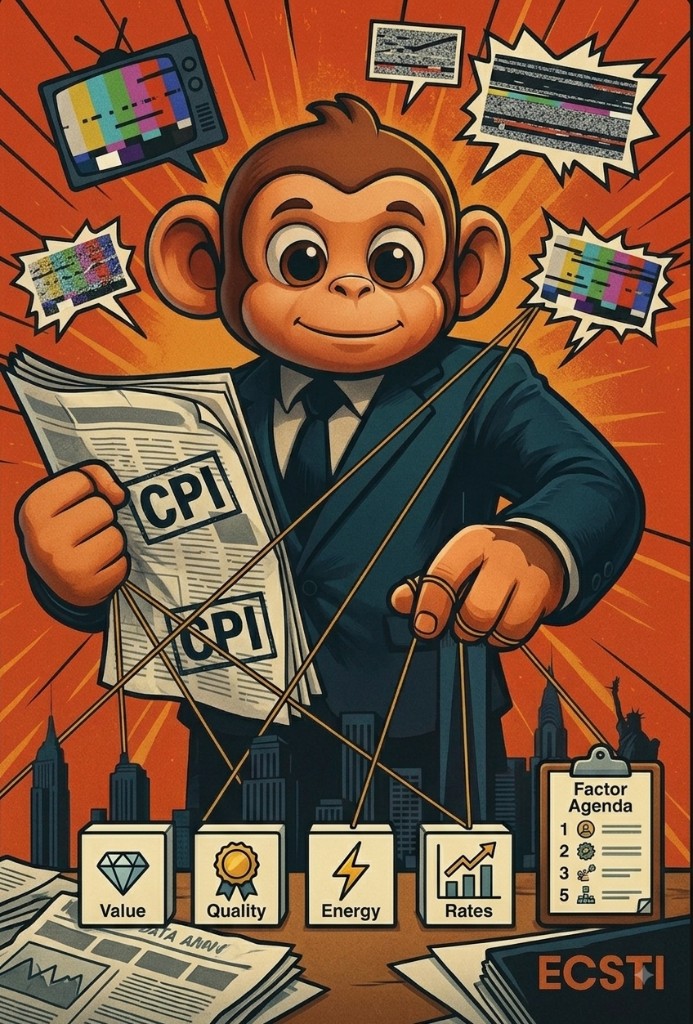
The CPI number drops. Timelines explode. Someone on TV says the Fed will hike, cut, pause, or invent a fifth verb.
Your job is quieter. Take the print. Update the map. Rebuild today’s factor agenda.
The Hook:
The print is not the plan.
On August 12, 2026, the U.S. Bureau of Labor Statistics reported that the Consumer Price Index for All Urban Consumers rose 0.1% in July and 3.4% over the last 12 months. Core CPI (all items less food and energy) rose 0.2% on the month and 2.5% over the year. Shelter rose 0.1% and did a lot of the monthly work. Energy fell 1.5% in July but was still up 14.7% over the year.
That is the input. Hot takes are optional. A CPI factor agenda is the point.
Plain words
- CPI: a measure of consumer price inflation from the BLS.
- Core CPI: CPI without food and energy, watched for stickier pressure.
- Factors: rules-based traits (value, quality, momentum, low vol, and so on).
- Agenda: today’s ranked research list. What to check, in what order, and why.
Do not forecast the Fed for sport.
Re-rank the desk.
Read the mix, not only the headline
Headline 3.4% matched a common forecast path. Fine. The mix still matters for sleeves.
July 2026 checklist from the release
- Shelter: +0.1% m/m, still a big piece of the monthly rise.
- Energy: -1.5% m/m, +14.7% y/y. Monthly relief, yearly scar.
- Core: +0.2% m/m after a flat June. Stickiness watch.
- Food: +0.1% m/m, +3.0% y/y. Not the main drama, still on the card.
The print is not the plan.
If your process only reacts to “beat or miss,” you are trading the press release. If your process asks which factors and sleeves the mix stresses, you are doing research.
Translate CPI into factor questions
Factor investing is not a personality. It is a set of rules. After CPI, the rules stay. The ranking of today’s work changes.
| Signal in the print | Desk question | Agenda example |
|---|---|---|
| Core still firm | Is quality still earning its keep? | Review balance-sheet strength in growth names |
| Energy wild y/y | Is energy a factor tilt or a headline chase? | Check energy sleeve vs mandate caps |
| Shelter sticky | What breaks if rates stay higher for longer? | Stress rate-sensitive holdings |
| Fed path noisy | Did I confuse a forecast with a process? | Separate “watch” names from “act” names |
When energy risk is the loud input, pair this with Oil Still Runs the World. Same idea: process first, personality rewrite never.
A one-page agenda for print day
Headline CPI / core CPI (write the numbers):
What moved inside (energy, shelter, food, other):
Mandate still valid? (yes/no)
Factors in force today:
Sleeves to check (max 5):
Names that only look smart on TV (ignore list):
Kill criteria if I am wrong:
What chat may draft (notes only):
What I will not change tonight (custody, size rules):
Fill that before you rewrite your book. If a tool cannot help you fill it, you do not have a research agent. You have a tip machine on CPI day. See also AI investing agent vs stock screener: filters are not a desk.
The print is not the plan.
What not to do
- Do not turn one print into a new investment religion.
- Do not confuse energy’s monthly drop with “inflation is solved” while yearly energy is still hot.
- Do not let chat invent factor definitions you never wrote down.
- Do not skip portfolio monitoring because the headline felt “in line.”
How this maps to ECSTI
Print days are when DIY investors bounce hardest: noise up, process down. ECSTI is for the opposite move. Encode the mandate. Keep the factors. Get today’s agenda when the data lands.
ECSTI research agents help perform that workflow while you stay in control of capital. You are welcome to try a few agents free on the platform.
Write the numbers. Re-rank the work. Leave the Fed soap opera to people who do not have a mandate. The print is not the plan.
Bottom Line
July CPI: +0.1% m/m, +3.4% y/y. Core: +0.2% / +2.5%. Energy soft on the month, still loud on the year.
Use the mix to rebuild a factor agenda.
Forecasts are entertainment. Agendas are work. Remember the hook: the print is not the plan.
The print is not the plan.
Related reading
Want today’s agenda from rules you already trust when the print hits?
Try a few ECSTI agents free. Research workflow, you keep custody.
Disclaimer: This is for learning only, not financial advice. Macro data changes. Nothing here is a recommendation to buy or sell any security. Do your own research and talk to a qualified professional before you invest. CPI figures cited from the U.S. Bureau of Labor Statistics July 2026 Consumer Price Index release.
Questions, answered.
What should investors do after a CPI print?
Update the facts, check what moved inside the print (energy, shelter, core), then re-rank today’s research agenda against your mandate. Do not rewrite your whole process because one number was loud.
How does CPI affect factor investing?
Inflation and the Fed path can change which factors lead for a while: duration-sensitive growth, value, quality, energy exposure, and low volatility can rotate. Factors are rules. The agenda is how you apply them after new data.
What was the July 2026 CPI number?
According to the U.S. Bureau of Labor Statistics, the CPI-U rose 0.1% in July and 3.4% over the last 12 months. The index for all items less food and energy rose 0.2% in July and 2.5% over the year.
Is a soft CPI always good for stocks?
No. Markets care about the mix inside the print, the Fed path, and what was already priced. A calm headline with sticky shelter or wild energy can still change sleeves. Treat CPI as input, not a buy signal.
Should I change my investment mandate after every CPI release?
Usually no. Mandates change on purpose, not on vibes. Rebuild the agenda first. Change the mandate only if your goals, risk budget, or long-term process actually changed.
How can an AI investing agent help on CPI day?
A research agent can re-rank today’s work from rules you already set: which holdings to check, which factors to stress-test, what to ignore. It should not invent a new personality because the print was on TV.
What is the difference between forecasting CPI and using CPI in a research agenda?
Forecasting tries to guess the number. An agenda asks what the published number implies for your sleeves and what to research next. Power users get paid for the second job.
Why did energy matter in the July 2026 CPI report?
Energy fell 1.5% in July but was still up 14.7% over the year in the BLS release. Monthly relief and yearly pressure can both matter for portfolios. Check both horizons before you rewrite sleeves.