
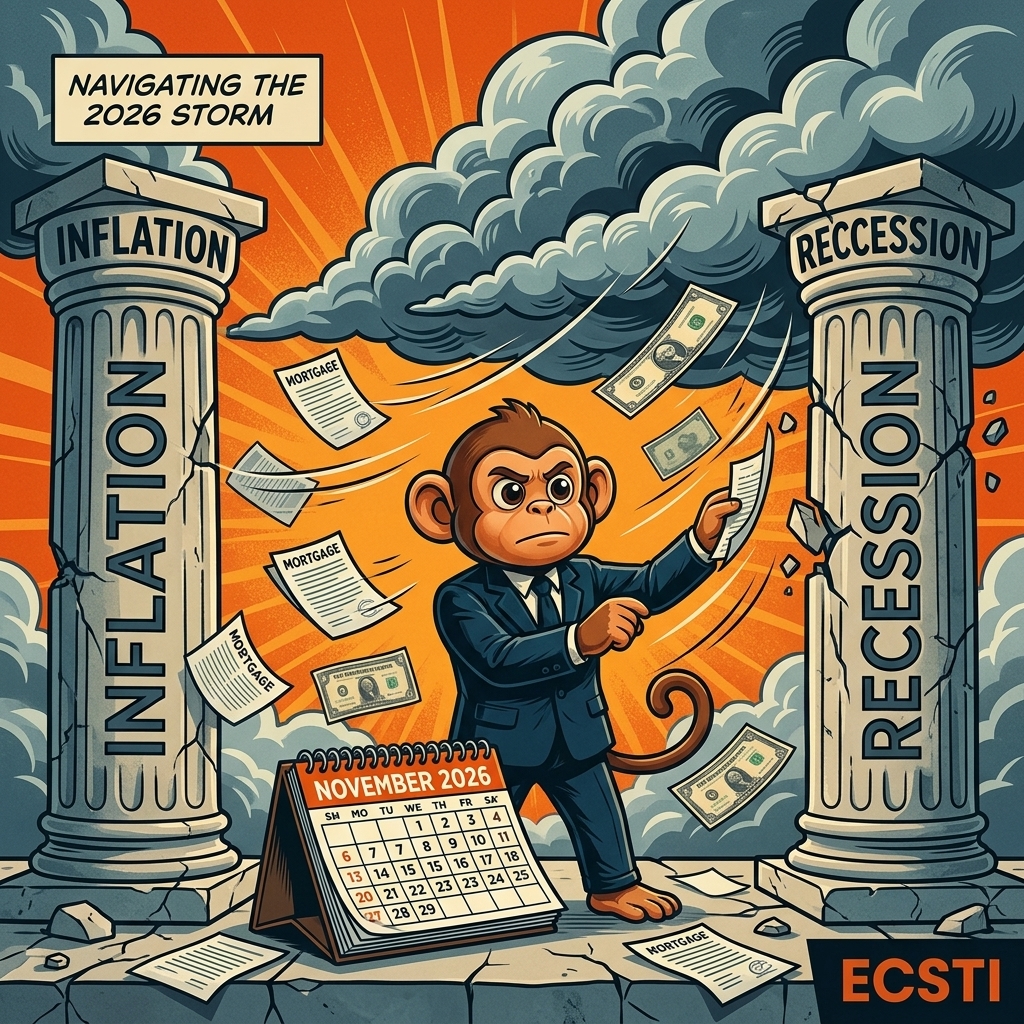
The Federal Reserve is trapped. In September 2026, a second wave of tariff-driven inflation is pushing 10-year Treasury yields past 4.8% and 30-year mortgage rates to 7.6%.
The 2026 re-acceleration of tariff-driven inflation traps the Fed in a political-economic bind where rate moves risk amplifying either inflation or recession fears, with housing and regional bank stability becoming key transmission channels of policy paralysis.
This surge coincides with a nor'easter disrupting Northeast supply chains, gasoline prices above $3.90 per gallon, and the 2026 midterm elections six weeks away.
The Fed cannot hike without worsening housing and regional bank stress. It cannot cut without validating inflation expectations.
Policy paralysis is now priced in. The transmission mechanism has shifted from equities to housing, credit, and political economy.
What is happening?
Tariff-driven inflation is re-accelerating in late 2026 due to new import restrictions on Chinese EV components, European steel, and Canadian energy products, combined with a nor'easter disrupting Northeast logistics and gasoline prices above $3.90 per gallon.
These cost pressures are feeding into consumer prices and bond markets, with the 10-year Treasury yield rising to 4.8% and mortgage rates climbing to 7.6%, just six weeks before the 2026 midterm elections.
Why markets should care
The Fed now faces a lose-lose scenario where hiking rates risks deepening housing and regional banking stress, while cutting rates validates inflation expectations and undermines credibility.
Unlike 2025, when the tariff shock was isolated, this wave hits amid tighter affordability, higher baseline rates, and immediate political pressure, reducing policy flexibility and increasing financial stability risks.
First-order effects
New tariffs on intermediate goods raise input costs for manufacturers and utilities, which are passed through to consumers and borrowers.
Bond yields rise as inflation expectations re-ignite, reducing real yields and pushing investors to demand higher nominal returns on Treasuries.
Mortgage rates increase and spreads widen relative to 10-year yields as agency MBS investors demand higher risk premiums amid political and rate uncertainty.
Housing affordability deteriorates sharply in swing states like Pennsylvania, Georgia, and Arizona, where median home prices exceed $400,000 and first-time buyers are priced out.
Second-order effects
Regional banks face margin pressure and higher credit risk as rising rates compress net interest margins and declining home prices increase loan-to-value ratios in CRE and mortgage portfolios.
Homebuilder sentiment declines as refinancing locks in high rates and new construction demand slows, especially for entry-level homes priced above $400,000.
Residential and retail REITs see valuation multiples contract due to higher discount rates and weakening occupancy in suburban and secondary markets.
Consumer discretionary spending softens outside luxury segments as households face pressure from high gas prices, mortgage costs, and rent.
Who could benefit?
Energy producers benefit from elevated oil and gas prices driven by supply disruptions and geopolitical tensions, boosting near-term margins for shale and refining firms.
Short-duration Treasury ETFs outperform long-duration bonds as investors rotate out of rate-sensitive fixed income amid expectations of prolonged policy uncertainty and flat or inverted yield curves.
Defensive sectors such as utilities and consumer staples may see relative outperformance as investors seek stable cash flows in a volatile macro environment.
Who could be exposed?
Long-duration growth equities, particularly in tech and green infrastructure, face valuation headwinds as higher real rates reduce the present value of distant cash flows.
First-time homebuyers and low-income households are excluded from the housing market as mortgage rates, rents, and gasoline prices simultaneously spike, eroding disposable income.
Mortgage REITs with high duration exposure and limited hedging face capital erosion as spreads fail to keep pace with rising funding costs.
Bull case vs bear case
Bull case: The Fed holds rates steady while inflation moderates by early 2027 due to base effects and global supply normalization, allowing housing and regional banks to stabilize without a crisis.
Bear case: Tariff retaliation escalates, inflation remains sticky above 4%, and the Fed is forced to hike late, triggering a housing downturn, regional bank stress, and a pre-election recession that shifts the midterm balance.
What to watch next
October CPI and PPI prints will confirm whether tariff and energy cost pass-through is broadening beyond goods into services.
November midterm election results could shift regulatory and fiscal trajectories, especially if one party gains control of both chambers.
Regional bank earnings in Q3 2026 will show credit loss provisions and CRE exposure trends, with KBW Regional Banking Index (KRX) as a key barometer.
Treasury Inflation-Protected Securities (TIPS) breakevens will signal whether inflation expectations are de-anchoring beyond 2026.
How an autonomous investment agent could approach this
A development like this illustrates why investment research increasingly requires continuous monitoring rather than one-time analysis. An autonomous research agent could track tariff announcements, bond yields, mortgage spreads, regional bank balance sheets, and political risk simultaneously, then test how those signals affect an investor-defined mandate in real time. ECSTI lets investors create autonomous research agents around their own investment rules, so those agents can continuously monitor developments like these and test new hypotheses through paper trades.
ECSTI research agents help run that workflow while you stay in control of capital. You are welcome to try a few agents free on the platform.
Bottom Line
The 2026 re-acceleration of tariff-driven inflation traps the Fed in a political-economic bind where rate moves risk amplifying either inflation or recession fears, with housing and regional bank stability becoming key transmission channels of policy paralysis.
Related reading
Want an agenda from rules you already trust?
Try a few ECSTI agents free. Research workflow, you keep custody.
Disclaimer: This is for learning only, not financial advice. Nothing here is a recommendation to buy or sell any security. Do your own research and talk to a qualified professional before you invest.
Questions, answered.
Why is the Fed caught between inflation and recession in 2026?
The Fed is caught because tariff-driven inflation is re-accelerating just before the midterms, forcing a choice between hiking and risking a housing-led downturn or cutting and validating inflation expectations. Neither option is clean, and political timing limits maneuverability.
What happens if the Fed raises rates amid tariff-driven inflation and midterm pressure?
Raising rates would validate inflation concerns but worsen housing affordability and increase default risks in mortgage and CRE portfolios, especially at regional banks. It could also trigger a pre-election downturn, increasing political fallout.
Which companies in the financial and real estate sectors are most at risk from Fed policy paralysis in 2026?
Regional banks with high CRE exposure, mortgage REITs with long duration and limited hedging, and homebuilders focused on entry-level markets are most at risk. Stocks like those in the KBW Regional Banking Index (KRX) and iShares Mortgage Real Estate Capped ETF (REM) face structural headwinds.
How do tariffs lead to higher mortgage rates and impact home affordability?
Tariffs raise import prices, increasing inflation expectations and pushing up 10-year Treasury yields, which anchor mortgage rates. Higher rates reduce monthly payment capacity, especially for first-time buyers, compressing demand and slowing turnover in key markets.
What does Fed policy uncertainty mean for investors in XHB and REM ETFs?
XHB, which holds homebuilders, faces demand risk as higher mortgage rates reduce buyer traffic and increase cancellations. REM, which holds mortgage REITs, faces duration and spread risk as funding costs rise faster than yields. Both ETFs are vulnerable to policy paralysis.
Which regional banks are most exposed to rising mortgage rates and housing downturns in 2026?
Regional banks with high loan-to-value ratios in residential and commercial real estate, particularly in Northeast and Sun Belt markets, are most exposed. Those with limited deposit diversification and high reliance on mortgage servicing income face added risk.
How might TIPS perform if tariff-induced inflation persists through 2026?
TIPS would outperform nominal Treasuries if tariff-induced inflation persists, as their principal adjusts with CPI. However, real yields may remain negative if inflation expectations rise faster than TIPS coupon adjustments, limiting upside.
What happens to consumer discretionary spending if mortgage rates spike under Trumpflation 2.0?
Consumer discretionary spending outside luxury segments would soften as households face higher mortgage payments, rent, and gasoline prices. Budgets are strained, reducing disposable income for non-essential purchases, especially in suburban and lower-income areas.