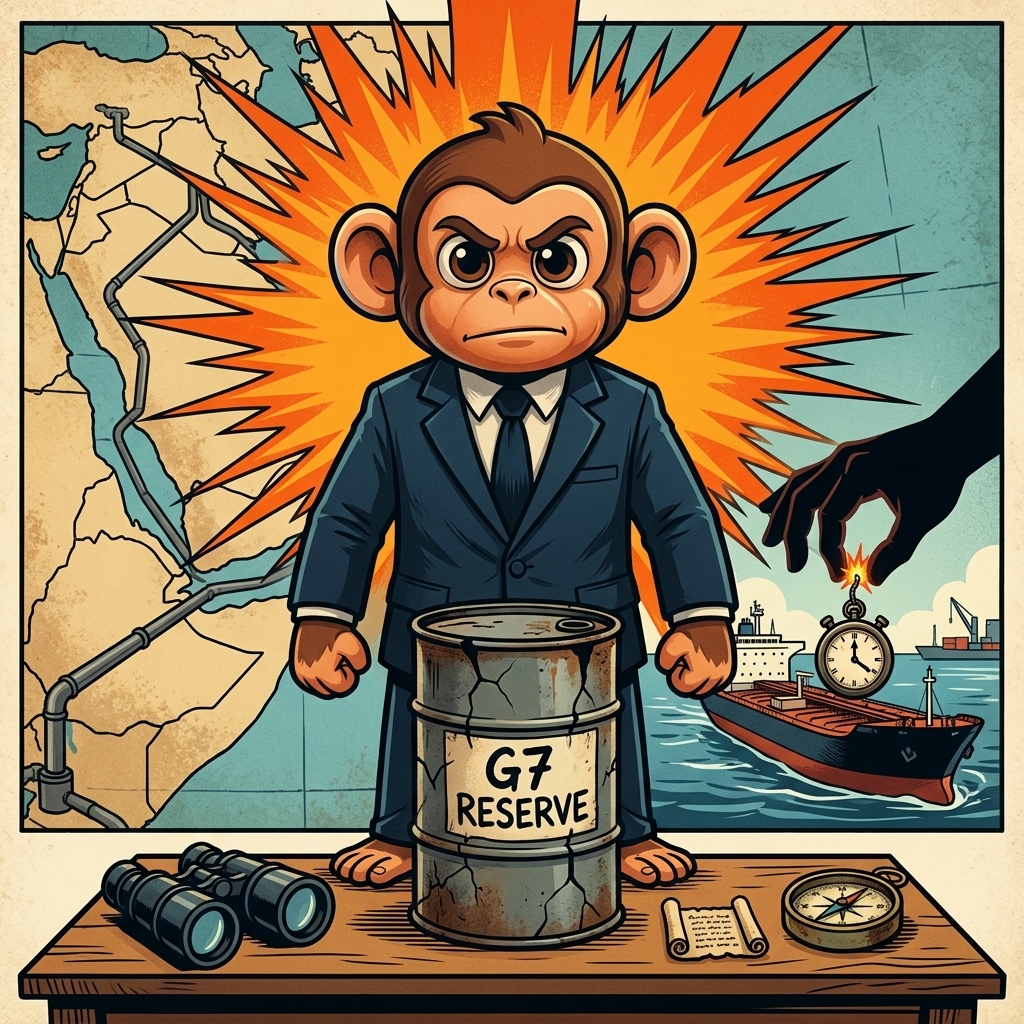

On August 22 and 23, 2026, two separate escalation signals arrived within roughly 24 hours. Iran's security chief Mohsen Rezaei publicly warned neighboring countries that joining the US-led economic pressure campaign would be treated as an act of war. Separately, a US envoy assessing Israel's recent Syria strike characterized it, in diplomatic language, as a possible deliberate provocation toward Turkey. That second framing is an interpretive diplomatic assessment, not a confirmed military finding, and it has not been officially confirmed by the State Department as of this writing.
The Hook:
Two simultaneous escalation signals, one from Iran toward Gulf states and one from the Israel-Syria-Turkey corridor, share the same downstream assets in energy and defense. The compounding argument is not a mathematical certainty but a structural observation: a hedge built around one thread does not neutralize exposure to the other, so the effective cost of protection rises faster than either signal alone would justify. That is the insight most single-thread news coverage misses.
On August 22 and 23, 2026, two separate escalation signals arrived within roughly 24 hours. Iran's security chief Mohsen Rezaei publicly warned neighboring countries that joining the US-led economic pressure campaign would be treated as an act of war. Separately, a US envoy assessing Israel's recent Syria strike characterized it, in diplomatic language, as a possible deliberate provocation toward Turkey. That second framing is an interpretive diplomatic assessment, not a confirmed military finding, and it has not been officially confirmed by the State Department as of this writing.
Either signal alone would move crude options and defense order books. Together they create a structural problem for portfolio managers trying to hedge a Middle East escalation oil and defense portfolio hedge: the two threads do not point at the same geography, but they share the same downstream assets. Brent crude, US defense primes, tanker freight rates, and gold all sit at the intersection of both vectors. That overlap is the core of the compounding argument this article examines.
What changed on August 22 and 23, 2026?
Iran's warning to Gulf neighbors is not new in tone, but the timing and framing carry more weight than usual. The US announced what it called a crushing economic operation against Iran on August 20, and the administration publicly told allies to choose sides. Rezaei's response named economic alignment with the US as an act of war, which is a harder public commitment than prior Iranian statements that left Gulf states room to quietly cooperate without formal acknowledgment.
The Israel-Syria-Turkey thread is more uncertain. The US envoy's characterization of the Syria strike as a possible provocation toward Turkey is an interpretive diplomatic read, not a confirmed intelligence finding. It has not been officially retracted or confirmed as of August 23. That ambiguity matters because markets price the possibility of NATO-adjacent escalation differently from a confirmed military event. The risk here is probabilistic, not operational.
Why the risk premium may compound rather than add
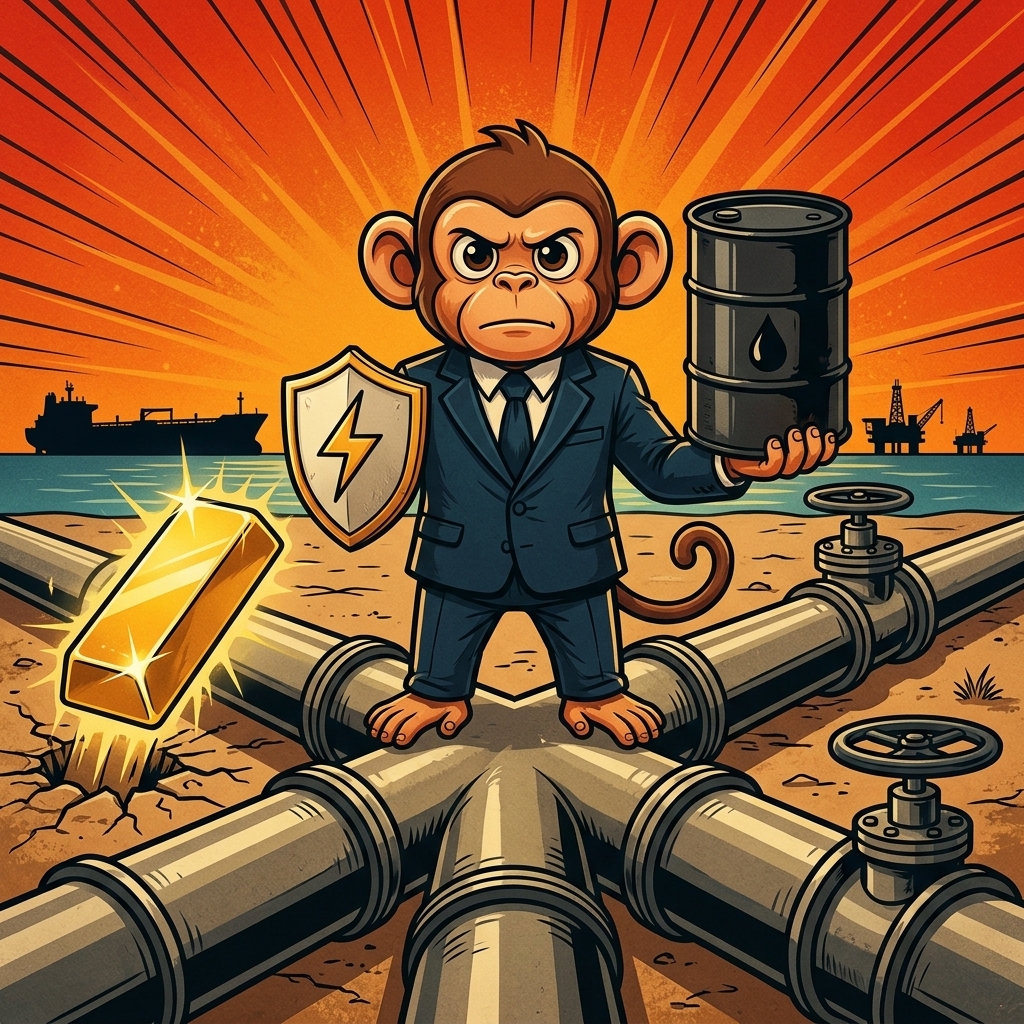
The compounding argument is a structural observation, not a mathematical model. When a portfolio manager hedges the Iran-Gulf thread by buying crude calls or adding upstream equity exposure, that position does not reduce exposure to a Turkey-NATO escalation that also lifts defense spending and disrupts regional shipping. The two hedges are not substitutes. They address different geographies but draw on the same pool of assets, so adding one position can increase concentration rather than reduce it.
Historical precedent supports the direction of the argument without proving the magnitude. During the 2019 Abqaiq-Khurais attack, crude spiked and defense equities moved in the same session. During the 2020 Soleimani period, gold, crude, and defense all moved together for several days before diverging. Neither episode involved a simultaneous NATO-adjacent vector, which is what makes the current dual-thread structure harder to hedge cleanly. The compounding claim is a thesis, not a certainty, and it depends on both threads remaining active at the same time.
First-order effects: crude, defense primes, and tanker freight
Brent crude implied volatility rises when Strait of Hormuz disruption probability increases. Roughly 20 percent of global seaborne oil transits the strait, a figure cited consistently by the IEA and EIA. A credible Iranian threat to Gulf states that cooperate with US sanctions raises the perceived probability of supply disruption, which options desks price into the left tail of crude contracts. Spot prices find a near-term floor even without an actual supply event because producers and traders add precautionary length.
US defense primes including Lockheed Martin, RTX, and Northrop Grumman see order flow support when Gulf states face a credible threat and accelerate existing US weapons contracts. The NATO-adjacent Turkey vector adds a second procurement rationale for European alliance members. VLCC and Suezmax tanker operators such as Frontline benefit when Hormuz closure risk forces cargo owners to price in Cape of Good Hope rerouting, which adds roughly 15 to 20 days of transit and tightens effective vessel supply. These are plausible directional effects, not guaranteed outcomes.
Second-order effects: LNG, gold, and war-risk insurance
A credible Hormuz closure threat pushes Asian LNG buyers toward Atlantic Basin cargoes. That competition tightens supply available to European buyers who already carry elevated energy cost sensitivity from the 2022 price shock. The transmission mechanism runs from crude risk premium into natural gas futures, then into European industrial input costs. This is a second-order effect that requires the first-order Hormuz threat to remain credible for more than a few days to transmit meaningfully into TTF pricing.
Gold benefits from the dual-thread structure because the usual mean-reversion argument weakens. In a single-thread escalation, markets often price in a resolution timeline. When two independent threads are active simultaneously, the probability that both resolve quickly is lower than the probability that either resolves alone. War-risk insurance underwriters price across geographic zones, not individual chokepoints, so dual escalation covering both the Gulf and the Syria-Turkey corridor expands the zone of elevated premiums for all vessels in the broader region. These are plausible mechanisms, not confirmed market moves.
Bull case and bear case for energy and defense exposure
The bull case for holding energy and defense exposure here rests on the dual-thread structure remaining active long enough to force procurement acceleration and sustained crude floor pricing. Gulf states that publicly reject Iran's warning and accelerate US arms contracts would confirm the first-order defense thesis. Tanker AIS data showing early rerouting behavior away from Hormuz would confirm the freight rate thesis. Gold holding above recent support while both threads remain open would confirm the safe-haven bid.
The bear case is that both threads de-escalate through back-channel diplomacy faster than markets can reprice. Iran's warning may be assessed by Gulf states as rhetorical rather than operational, capping the Hormuz probability repricing. The US envoy's Turkey-provocation framing could be walked back by official State Department channels, removing the NATO-adjacent vector entirely. A rapid ceasefire in the Syria corridor would leave only the Iran-Gulf thread, which is a more familiar and more easily hedged single-thread story. Demand destruction from a broader global slowdown could also offset the supply-side risk premium in crude, leaving energy equities flat despite the geopolitical signal.
What to watch next
The most important near-term signals are official Gulf state responses to Iran's warning, particularly public statements from Saudi Arabia and the UAE, and any State Department clarification or retraction of the Turkey-provocation framing from the Syria envoy. If Gulf states publicly distance themselves from the US economic campaign, the Iran thread becomes more operationally credible. If the State Department walks back the Turkey framing, the NATO-adjacent vector loses its market relevance.
Tanker AIS tracking for early Hormuz rerouting behavior, Brent 30-day implied volatility and skew, and USD/TRY daily fixing for capital flow signals are the three data streams that would confirm or deny the dual-thread thesis in real time. LMT, RTX, and NOC contract announcement calendars and any accelerated Gulf client communications would confirm the defense procurement thesis. IEA and EIA weekly crude inventory data would show whether demand-side factors are offsetting the supply risk premium.
How an autonomous investment agent could approach this
A development like this illustrates a specific workflow problem: two escalation threads that share downstream assets require continuous monitoring across crude options markets, defense contract announcements, tanker AIS data, diplomatic statement feeds, and currency fixing data simultaneously. Checking any one of those streams in isolation misses the compounding structure. An autonomous investment research agent built around a geopolitical risk mandate could track all of those signals in parallel, flag when two independent threads converge on the same asset class, and test how prior dual-escalation episodes affected energy and defense factor exposure, without requiring a portfolio manager to monitor every feed manually. ECSTI lets investors build research agents around their own investment mandate so those agents can surface convergence signals like this and test hypotheses through paper trades before committing capital. More at ecsti.io/platform.
ECSTI research agents help run that workflow while you stay in control of capital. You are welcome to try a few agents free on the platform.
Bottom Line
Two simultaneous escalation signals, one from Iran toward Gulf states and one from the Israel-Syria-Turkey corridor, share the same downstream assets in energy and defense. The compounding argument is not a mathematical certainty but a structural observation: a hedge built around one thread does not neutralize exposure to the other, so the effective cost of protection rises faster than either signal alone would justify. That is the insight most single-thread news coverage misses.
Two simultaneous escalation signals, one from Iran toward Gulf states and one from the Israel-Syria-Turkey corridor, share the same downstream assets in energy and defense. The compounding argument is not a mathematical certainty but a structural observation: a hedge built around one thread does not neutralize exposure to the other, so the effective cost of protection rises faster than either signal alone would justify. That is the insight most single-thread news coverage misses.
Related reading
Want an agenda from rules you already trust?
Try a few ECSTI agents free. Research workflow, you keep custody.
Disclaimer: This is for learning only, not financial advice. Nothing here is a recommendation to buy or sell any security. Do your own research and talk to a qualified professional before you invest.
Questions, answered.
Why does risk premium compound instead of adding when two Middle East conflicts escalate at the same time?
The compounding effect is structural, not mathematical. When two escalation threads share the same downstream assets, a hedge built for one thread does not reduce exposure to the other. Adding crude calls to hedge Iran-Gulf risk does not offset a NATO-adjacent Turkey escalation that also lifts defense spending and disrupts regional shipping. The effective cost of protection rises faster than either signal alone would justify because the two positions increase concentration rather than diversify it.
What happens to Brent crude futures if Iran escalation and a Turkey NATO conflict occur in the same week?
Brent crude implied volatility rises and spot prices find a near-term floor because options desks reprice the Hormuz disruption probability upward while the NATO-adjacent vector adds a second rationale for precautionary length. The magnitude depends on whether Gulf states publicly respond to Iran's warning and whether the Turkey framing is confirmed by official US channels. Neither outcome is guaranteed, and demand-side factors could offset the supply risk premium.
Which defense stocks benefit most when Middle East escalation involves both Iran and an Israel Syria confrontation simultaneously?
US defense primes with Gulf state client exposure, including Lockheed Martin, RTX, and Northrop Grumman, see order flow support when dual escalation accelerates procurement timelines. Gulf states under Iranian threat historically fast-track existing US weapons contracts. The NATO-adjacent Turkey vector adds a second procurement rationale for European alliance members. These are plausible directional exposures, not guaranteed outcomes, and depend on escalation remaining active long enough to force contract acceleration.
How does Iran's economic war warning affect oil prices and downstream energy equity exposure?
Iran's warning raises the perceived probability of Strait of Hormuz disruption, through which roughly 20 percent of global seaborne oil transits according to IEA and EIA data. That probability increase lifts the cost of downside hedges in crude options and pulls spot prices higher as producers add precautionary length. Upstream crude equities see beta expansion during the repricing window. The effect is capped if Gulf states treat the warning as rhetorical rather than operational.
Which tanker and war-risk insurance companies gain when Gulf shipping lanes face dual threat scenarios?
VLCC and Suezmax operators such as Frontline benefit when Hormuz closure risk forces cargo owners to price in Cape of Good Hope rerouting, which adds roughly 15 to 20 days of transit and tightens effective vessel supply, pushing spot freight rates higher. War-risk insurance underwriters price across geographic zones, so dual escalation covering both the Gulf and the Syria-Turkey corridor expands the zone of elevated premiums for all vessels in the broader region, not just Hormuz-corridor traffic.
What happens to gold when both energy and defense risk premiums spike at the same time?
Gold benefits because the usual mean-reversion argument weakens under a dual-thread structure. In a single-thread escalation, markets often price in a resolution timeline. When two independent threads are active simultaneously, the probability that both resolve quickly is lower than the probability that either resolves alone. That sustained uncertainty supports a higher floor for gold rather than a spike-and-fade pattern. The effect is plausible but depends on both threads remaining active concurrently.