

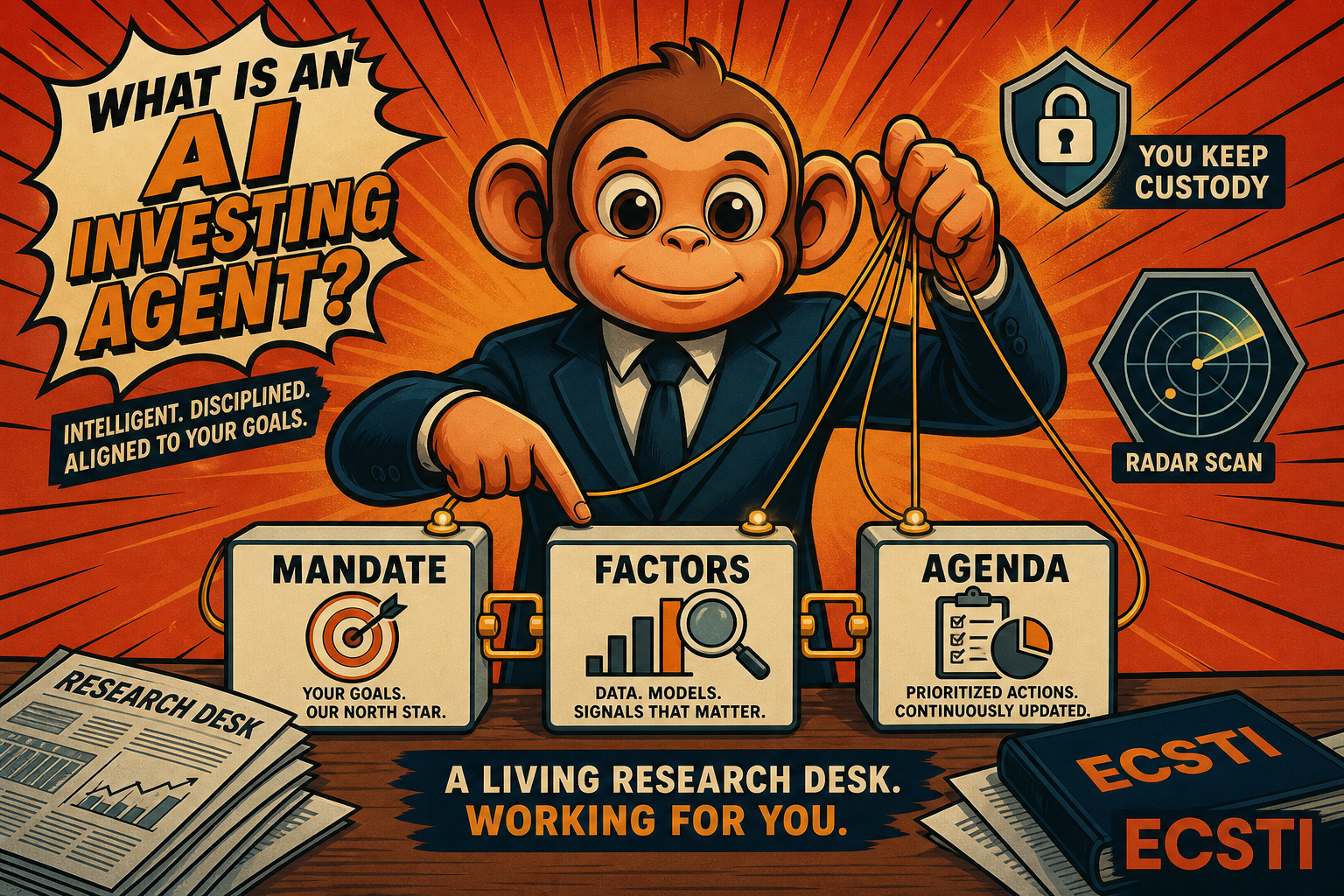
An AI investing agent should mean software that can run a multi-step investing job (research, monitoring, screening, agenda-building) with memory of your constraints.
In practice, the phrase got stretched over chatbots, robo-advisors, bots, and autopilot toys. So we need a map.
The Hook:
Chatbot = answers once.
Robo = allocates a model portfolio for you.
Research agent = runs your process and surfaces today’s worklist.
Autopilot = can place or route trades.
Same phrase. Different product.
If you want the filter layer on ECSTI, it is here: the ECSTI screener.
In 2026 the words collided: agentic AI, agentic AI investing (a phrase that is rising in search), AI investing, investing co-pilot, AI stock analysis. The exact term AI investing agent is quieter this week. That is fine. Category pages are for clarity, not for chasing one spike. Brokerages wire chat into order tickets. Macro weeks (CPI data release, rates, energy vs tech) make tip culture louder. Open-source “trading agents” show loud backtests and quieter caveats.
Plain words
- Mandate: your investing rules.
- Factors: traits like value, quality, momentum, low vol.
- Agenda: today’s focus list.
- Custody: who holds and can move the money.
If you already run a stock portfolio with factors, a screener, and a watchlist, you do not need another essay generator.
You need to know what an agent is allowed to do with your process and your capital.
The lazy version
The lazy version: if it uses an LLM and mentions stocks, it is an “AI investing agent.”
Same phrase. Different product.
What you are actually looking at
- General chatbots: great for concepts and critique. Weak on mandate memory and a repeatable daily agenda.
- Robo-advisors: model portfolios and rebalancing. Useful for some people. Not the same job as encoding your factor process.
- Rule-based trading bots: if-then automation. Clear when the rules are yours. Brittle when the regime changes.
- Research agents: screen, track, remember factors, produce today’s focus list. You decide. You execute. Custody stays with you.
- Execution / autopilot agents: can draft or submit orders. Different product. Different risk.
ECSTI’s stance, stated plainly:
An investing agent should run your research process as a research tool. You keep custody and judgment. Autopilot is a separate decision, not a free upgrade.
ChatGPT stock analysis vs a mandate-aware agent
Most power users already tried ChatGPT on a ticker. The bounce is familiar: the prose sounds smart, then nothing persisted. Not your dividend + low-vol mandate. Not your screener rules. Not yesterday’s watchlist.
What chat helps with (and what it doesn’t)
- Helps: framing a thesis, stress-testing assumptions, drafting notes
- Fails: remembering your investment mandate across sessions
- Fails: binding answers to your factor definitions
- Fails: producing an agenda you can re-run tomorrow
ChatGPT stock analysis is a tool. An AI investing agent, if it exists, is a workflow with memory. Same phrase. Different product.
Deeper on the bounce: ChatGPT stock tips vs a research agenda. On the industry noun: what agentic AI means for DIY stock research.
What a serious research agent actually does
If you already speak in factors and rebuild the same loop in a screener, Sheets, and a broker every week, a useful agent should compress that loop.
Screen → thesis → agenda
- Mandate: persist “dividend + low vol” or “AI infra beneficiaries” across sessions
- Screen: apply your criteria to the universe
- Thesis: keep rationale attached to names
- Agenda: rank a focus list you can audit
- Adjust: update tilts with you, not for you
After one session, can you explain why a name is on today’s agenda in language you already trust? If the answer is “the model liked it,” you do not have an agent. You have a vibe.
Checklist before you paste a portfolio
- 1. Does it remember my mandate?
- 2. Can I audit the criteria?
- 3. Who holds custody?
- 4. What can it execute without me?
- 5. Is it research, advice, or a robo allocation product?
- 6. Does it produce an agenda, or an essay?
| Type | Memory of you | Moves capital? | Best use |
|---|---|---|---|
| Chatbot | Weak / session | No | Concepts, drafting, critique |
| Robo-advisor | Risk profile / model | Yes (allocation) | Hands-off model portfolios |
| Research agent | Strong (mandate) | No | Screen → thesis → agenda |
| Rule bot | Rules you wrote | Yes, by design | Tested execution |
| Autopilot agent | Varies | Often yes | Only if you accept execution risk |
How this maps to ECSTI
ECSTI is built for the semi-pro DIY investor who already has a stack (screener, notes, broker) and does not want another black box pretending to be a personality. The filter step is the ECSTI screener.
Encode your factors once. Get today’s investing agenda from an agent that runs your process. Not a generic chat about the stock market. Same phrase. Different product.
That is a research-agent definition. Not a robo pitch. Not an autopilot pitch. If you want a machine to trade your account while you sleep, look elsewhere. And read the custody terms twice.
Bottom Line
“AI investing agent” is a marketing umbrella. Underneath it sit chatbots, robo-advisors, research agents, rule bots, and autopilot systems with very different failure modes.
Research agents compress your process. Autopilot agents touch your capital.
Know which one you are buying. Demand the product say so in one sentence.
Same phrase. Different product. Custody is the tell.
Related reading
- AI Investing Agent vs Stock Screener
- ChatGPT Stock Tips vs a Research Agenda
- What Agentic AI Means for DIY Stock Research
- Energy Up, Tech Soft: How Power Users Handle Regime Rotation
- Don't Fear the VIX Bear: What You Should Know
Want to run filters first? Open the ECSTI screener.
Explore the ECSTI platform. Build an investing agent that encodes factors and returns today’s agenda. Research tool. You keep custody.
Disclaimer: This is for learning only, not financial advice. AI systems can be wrong. Nothing here is a recommendation to buy or sell any security. Do your own research and talk to a qualified professional before you invest.
Questions, answered.
What is an AI investing agent?
Software that runs a multi-step investing workflow (screening, monitoring, tracking ideas, or building today’s agenda) with memory of your rules and factors. Not just a one-off answer to a prompt.
Is ChatGPT stock analysis the same as an AI investing agent?
No. ChatGPT can help with concepts and a first pass. It does not keep your factor process, your watchlist rules, or an agenda you can re-run tomorrow unless a specialized system is built around it.
Is an AI investing agent a robo-advisor?
Usually not. A robo-advisor typically picks and rebalances a model portfolio for you. A research agent helps you run your own process while you keep custody and judgment.
Is an AI investing agent the same as a trading bot?
No. A trading bot follows fixed if-then rules to execute. An investing agent may research, plan, or (in some products) execute. Always check whether it can move capital and who holds custody.
What is the difference between a research agent and an autopilot agent?
A research agent compresses your process into today’s focus list while you keep custody. An autopilot or execution agent can draft or submit orders. Same marketing phrase. Very different risk.
What should factor investors look for in an AI investing agent?
Memory of your mandate, factor language you already use (value, quality, momentum, low vol), screens you can check, a daily agenda you can explain, and a clear research-tool stance. Not black-box buy signals.
What is agentic AI in investing?
Industry vocabulary for multi-step systems that plan and use tools. In investing it should still clarify research agenda vs capital moves. See our companion piece on agentic AI for DIY stock research.