

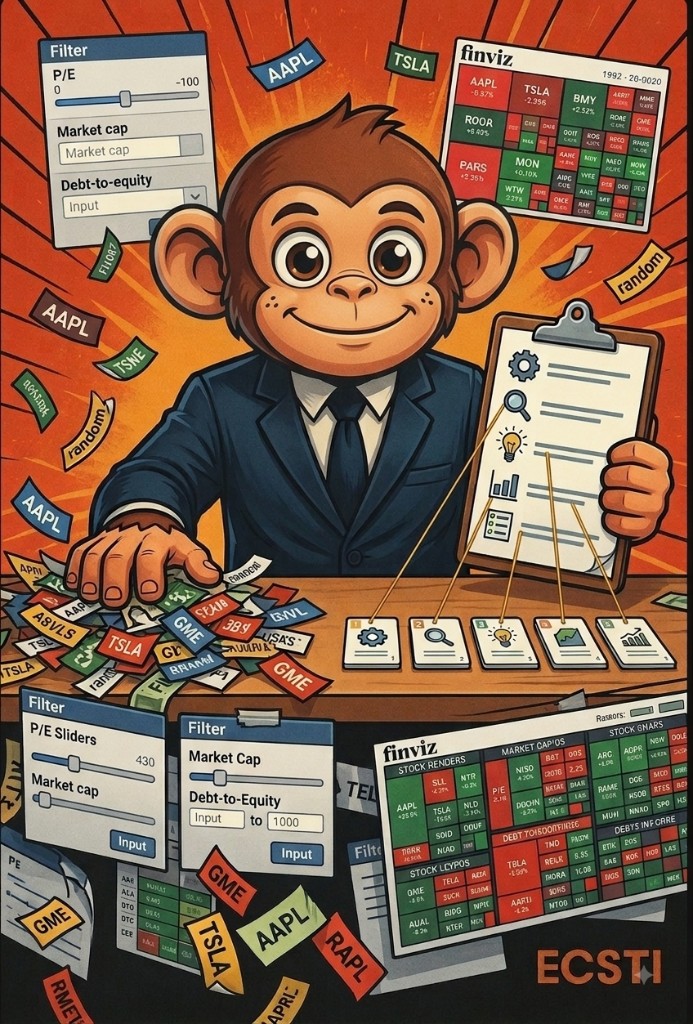
You open a stock screener. You set market cap, PE, volume, maybe a sector. A list appears. You feel organized.
Then the day gets loud. Oil moves. A print lands. Your chat window invents a new story. The list is still just a list.
The Hook:
Filters are not a desk.
If you want the filter layer on ECSTI, it is here: the ECSTI screener.
People search AI investing agent vs stock screener because the tools get sold as substitutes. They are not. A screener is a filter. An agent is supposed to run a research workflow. Confusing them is how you end up with a prettier FinViz and the same empty afternoon.
Search interest in stock screener stays high even when weekly growth is soft. That is the tell. DIY investors already live in filter tools. The upgrade is not “more filters.” It is a desk that remembers your rules.
Plain words
- Stock screener: a tool that filters a big universe by rules you set (numbers, sectors, liquidity).
- Mandate: your investing rules in one place (what you buy, avoid, and how you size risk).
- Factors: traits you care about, like value, quality, momentum, or low volatility.
- Agenda: today’s ranked focus list. What deserves desk time, and why.
Keep the screener.
Stop pretending the filter list is the research process.
What a stock screener is actually good at
A serious screener is honest machinery. You say “market cap above X, PE below Y, average volume above Z.” It returns matches. Same inputs, same outputs. That reproducibility is gold for factor investing.
Screener strengths
- Precision: hard numeric filters beat vibes.
- Speed: you shrink thousands of names to a short list.
- Auditability: you can explain why a name passed.
- Habit: most power users already speak screener fluently.
Filters are not a desk.
The lazy version of AI investing sells a chat window as if it replaced that machinery. Or it slaps “AI” on a score and calls the score an agent. Neither is a desk.
Where screeners stop (and people get stuck)
A filter list does not know your portfolio concentration. It does not remember that you already own three energy names. It does not decide what to research first today after CPI or a shipping shock. It does not write a kill criterion.
Common stuck points
- List ≠ agenda. Forty survivors is not a workday.
- No mandate memory. The screen can contradict rules you wrote last quarter.
- No second-order map. Filters do not translate a news event into sleeve questions.
- No portfolio context. Screening the market is not monitoring your book.
That is why “FinViz alternative” searches often miss the real job. You may not need a different screener. You may need the layer that turns survivors into today’s agenda.
What an AI investing agent should do instead
If the phrase AI investing agent means anything useful, it means a research agent: encode a mandate, keep factor definitions, pull or respect real data, rank today’s work, and leave custody with you. Pair that with a real factor agenda after noisy prints, not a tip dump.
| Job | Stock screener | Research agent |
|---|---|---|
| Apply hard filters | Excellent | Uses filters, does not replace them |
| Remember your mandate | No | Yes (that is the point) |
| Rank today’s desk work | No | Agenda output |
| Explain qualitative fit | Weak | Stronger when grounded |
| Move your money | No | Should not, if it is a research agent |
ChatGPT can draft notes about a ticker. That is not screening, and it is not an agent. Tip machines and filter boxes fail in different ways. Both can leave you with the same problem: filters are not a desk.
The stack that actually works
1. Mandate (written rules)
2. Factors (definitions you can defend)
3. Screener (hard filters, reproducible)
4. Agent / agenda (rank today's work)
5. You (judgment + custody)
6. Chat (optional drafting only)
If a product collapses steps 3 through 5 into “ask me anything,” you are back to tip theater. Smart prose. Empty desk. Different costume, same failure mode.
How this maps to ECSTI
ECSTI assumes you already know what a screener is for. If you want that filter step on ECSTI, it is here: the ECSTI screener. The missing piece is the research agent that turns your factors into today’s investing agenda while you keep the brokerage.
ECSTI research agents help perform that workflow: encode once, get a ranked agenda, stay in research mode. You remain in control. You are welcome to try a few agents free on the platform.
Keep the filters. Add the desk. An AI investing agent that cannot outrank a screener list into an agenda is just marketing on top of a table.
Bottom Line
Stock screeners are filters. They are necessary. They are not sufficient.
AI investing agents should run a process, not cosplay a PE slider.
If your “AI” cannot remember the mandate and produce today’s agenda, you still only have filters. And filters are not a desk.
Filters are not a desk.
Related reading
Want to run filters first? Open the ECSTI screener.
Then try a few ECSTI agents for today's agenda. You keep custody.
Disclaimer: This is for learning only, not financial advice. AI systems can be wrong. Nothing here is a recommendation to buy or sell any security. Do your own research and talk to a qualified professional before you invest.
Questions, answered.
What is the difference between an AI investing agent and a stock screener?
A stock screener applies filters and returns a list. An AI investing agent runs a multi-step research workflow against your rules, then ranks what deserves desk time today. Filters are one step. A desk is a loop.
Can AI replace a stock screener?
No, not if you care about precise, reproducible filters. AI can help design screens and explain results. It should not invent numbers or replace a real filter engine when you need exact criteria.
Is FinViz enough for serious DIY stock research?
FinViz-class tools are excellent for screening. They are not a full research desk. You still need a mandate, factor definitions, today’s agenda, and a way to check results against your portfolio rules.
What is a research agenda in investing?
A research agenda is today’s short, ranked focus list based on your rules. It answers what deserves your time right now and why, not which ticker won a vibe contest.
How should factor investors use a stock screener?
Encode factors as clear filters, run the screen, then review survivors against your mandate and portfolio constraints. Do not treat the raw list as a buy list.
Is an AI stock screener the same as an AI investing agent?
Usually no. Many “AI screeners” add scoring or chat on top of filters. A real investing agent remembers your process, updates an agenda, and stays in research mode while you keep custody.
Can ChatGPT replace FinViz?
No. Chat can talk about filters in words. It does not reliably apply live filters across a universe or keep your screen definitions consistent unless a real system is built around it.
What stack should a DIY investor use: screener, chat, or agent?
Use a screener for filters, chat for drafting and critique, and a research agent when you want today’s agenda from rules you already trust. The stack beats any single toy.